The Science of
Syncing
How we calculate the unique journey of you and your pet through high-precision metabolic mapping.
Start Calculating
Driven Results
Precision Beyond
the Rule of Seven
The standard 'multiply by seven' rule is a relic of the past. Our algorithm uses recent veterinary data that accounts for the non-linear biological development of companion animals.
Weight-Based Aging Curves
Size dictates lifespan. Smaller dogs often enjoy longer life cycles, while larger breeds
mature and age on a much faster timeline.

Small
Under 20lbs / 9kgSlowest Aging
Medium
20-50lbs / 9-23kgBalanced
Large
50-90lbs / 23-40kgAccelerated
Giant
90+lbs / 40kg+Rapid AgingA Note on Pet Weight
The weight categories reference the healthy, ideal adult weight of your pet's breed. For the most accurate biological age calculation, please select the weight your pet should be, and do not account for whether your pet is currently over or underweight.
How to Tell if Your Dog is at an Ideal Weight
A Body Condition Score (BCS) helps determine if your pet is carrying too much or too little weight. You should be able to feel their ribs easily without pressing through a thick layer of fat, and they should have a visible waist when viewed from above.
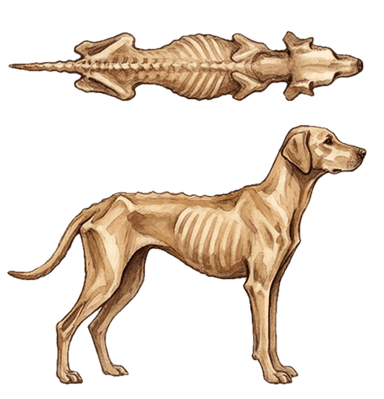
Very Thin
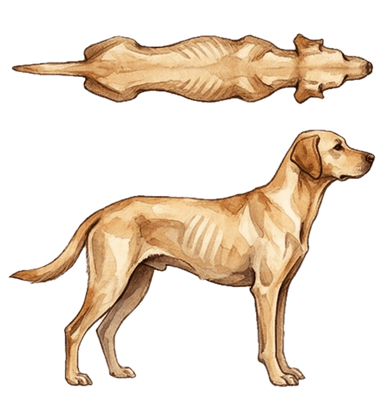
Thin

Ideal
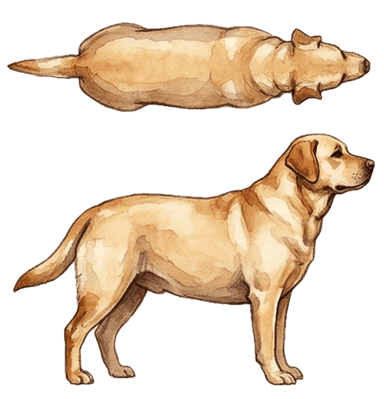
Overweight

Obesity
Ideal Characteristics
- Ribs, spine and hip bones are easily felt and may be visible (coat may interfere with visibility)
- A waist and abdominal tuck are seen when viewed from above and side
- Fat can be felt around ribs, spine and hip bones
Metabolic Milestones
Growth isn't linear. The first two years of a pet's life represent the most rapid phase of cellular development — equivalent to a human's jump from infancy to young adulthood. After reaching physical maturity, the pace softens significantly.

Puppy (birth to ~6-9 months)
This is the fast-growth, high-learning stage, and it includes the most important early socialization period, when safe, positive exposure to people, places, sounds, and handling can strongly shape later behavior.

Adolescence (6 months to ~18–24 months)
This is the canine "teenager" phase: more independence, more testing boundaries, and sometimes a return of fears or selective hearing. It is a very normal stage, but it is also when behavior problems often become more obvious if training and routines are inconsistent.

Adult (1.5–3 years to senior)
This is the steady stage where weight control, exercise, dental care, and preventive screening have the biggest long-term payoff.

Senior (Last 25% of expected lifespan)
This is when arthritis, sensory decline, organ disease, and cognitive changes become more common, so checkups and screening usually need to get more proactive.

Geriatric (Beyond average lifespan for breed)
Clinically, this is less about a birthday and more about frailty, function, and quality of life. A geriatric dog needs very individualized care.
Age Wisdom
Did you know? Most pets age the equivalent of 24 human years in just their first two birthdays. After that, the pace softens into a steady, beautiful rhythm.